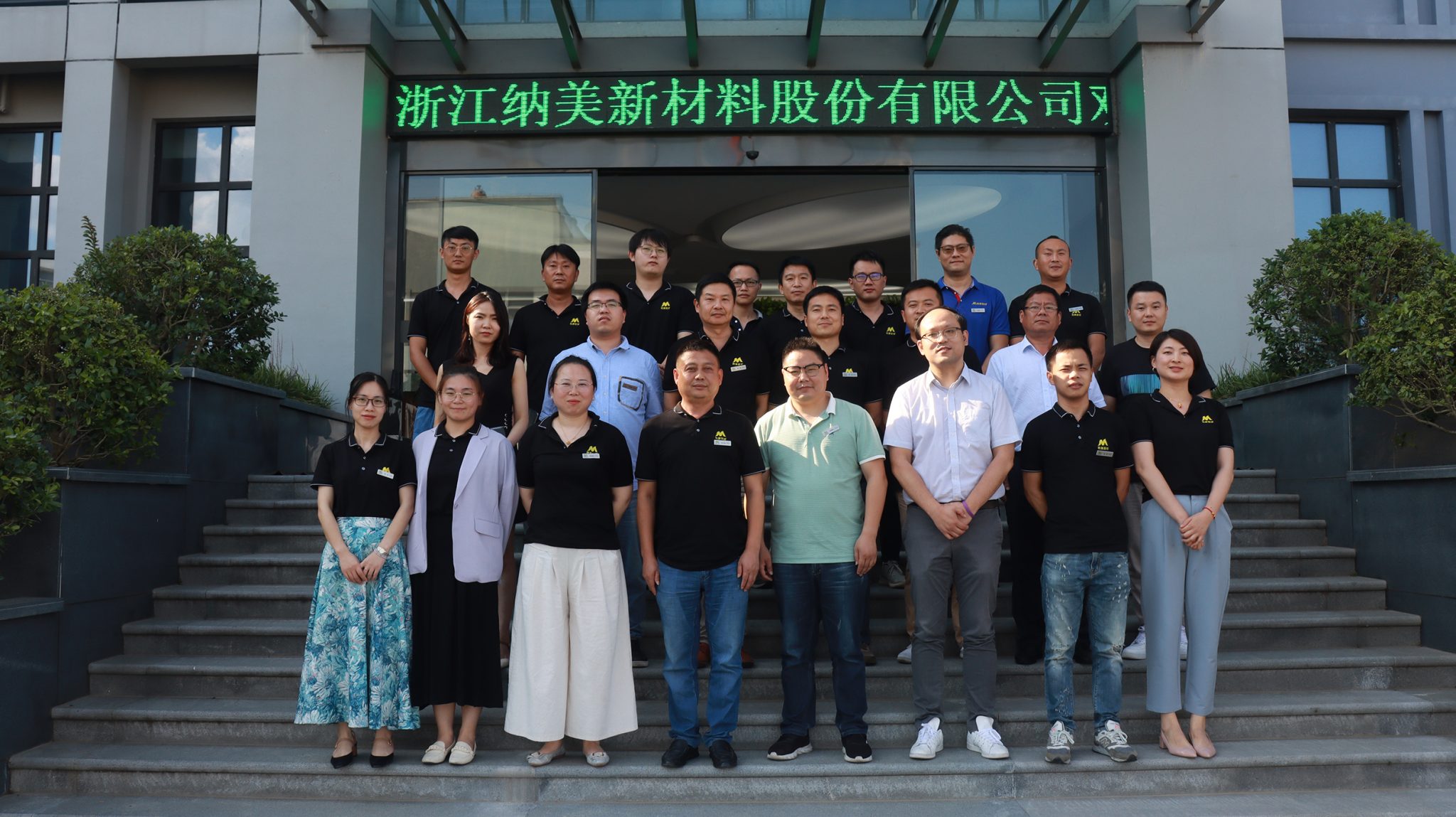
Sales of Zhejiang Namei Materical Technology achieve good performance

Compliance & Certification | Technical Application Colorant export is never simply “goods arrive and that’s it”—it is “documents first, compliance first.” The EU market has three hard thresholds: REACH, RoHS, and EN71-3. The United States has TSCA, Japan has CSCL, and the absence of any one of these can lead to return shipments, notifications, or […]
Applied Technology | Technical Parameters Tinting strength is one of the most core performance indicators of colorants, directly determining “how much is needed to achieve the target color,” thereby affecting cost and formulation space. Many colorant problems have their roots in cognition and measurement deviations of tinting strength—for example, for the same nominal red, one […]
Compliance & Certification | Technical Application Industrial coatings and food packaging are the two scenarios with the greatest differences in compliance requirements for colorant applications: the former looks at China’s Environmental Labeling (Ten-Ring) and VOC limits, while the latter looks at food contact regulations such as FDA and EC 1935/2004. The same colorant manufacturer faces […]
NAMEI Technical Digest | Technical Parameters When selecting and applying water-based colorants, a set of core parameters is unavoidable: solids content, particle size, viscosity, and pH. They are interrelated and mutually constrained, jointly determining tinting strength, stability, compatibility, and application performance. Viewing any parameter in isolation leads to pitfalls—for example, pursuing high solids content only […]
Modern Paint & Coating | Technical Application Viscosity is the core characterization of the rheological behavior of water-based colorants and runs through the entire chain of production, pumping, metering, mixing, and application. Water-based colorants are mostly pseudoplastic fluids (shear-thinning), and viscosity changes with shear rate—this is both an application advantage and a control difficulty. Abnormal […]
In-Depth Analysis of the Impact of Colorant Particle Size Distribution on Coating Performance: The Complete Chain from Tinting Strength to Gloss
Color Matching Techniques – Application of RGB and CMYK Thinking in Colorant Matching
“How much colorant should I add for this color?” is a question the color-matching station faces every day. Add too little and the color falls short; add too much and you waste cost, and may also affect the coating’s adhesion, scrub resistance, and gloss due to excessive pigment volume concentration. In actual production, there are […]
How to Use Colorants Correctly – A Complete Process Guide from Opening the Bucket to Application
2K PU Polyurethane Coating Colorants – The Dual Challenge of High Gloss and Weather Resistance